Aptrinsic

Showing posts with label psychology. Show all posts

9/26/2016

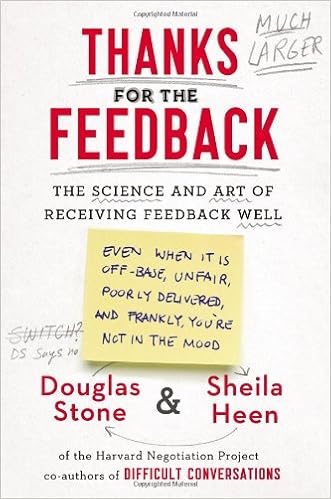
Thanks for the Feedback by Sheila Heen and Douglas Stone

This is the best book I’ve read this year. It has already given me lots of growth ideas both personally and professionally.  I recommend this book to anyone who wants to get better at listening, and especially to Product Managers where listening is an essential job function. Here are my key takeaways:

  1. Understand what’s beneath the label.  Our brains put order to the world by slapping a label on incoming data.  The feedback you get will come in the form of a label. Get under the label to understand 1) what the data is, and 2) where the feedback is coming from. A salesperson being told by the boss “you’re too laid back when you sell” is actually saying that the customer is interpreting the salesperson's gestures and language as a lack of care. “Laid back” was the label chosen here. The boss might have some experience with losing deals when customers feel this way, and that’s good information to find out.  Keep in mind that all feedback are autobiographical; it stems from the feedback-giver’s personal experience. So ask questions to uncover what’s beneath the label.
  2. Ask "What do you see me doing or failing to do that is getting in my own way?” Look for consistent feedback. Look for the same data with different interpretations.  Keep in mind that feedback is autobiographical, it is important to look under the label and uncover the data, which provides the patterns.
  3. Emotions distort the feedback.  Our feelings color the story we tell.  If we are frustrated we tell a frustrated story. If we are sad we tell a dark story. When we Google ourselves while in a good mood, we focus on all the great press; but when in a bad mood, we focus on the bad press. So the facts or thoughts we focus on will vary with our emotion.  This go both ways. Sometimes the thoughts cause emotion instead.  For example, I am running late to organize an event and start imagining all the possible disasters (thoughts).  this causes me to feel panicked that the event will fall apart without me (emotion). Now when I arrive and the tables are not delivered yet, I might jump to the conclusion that I have failed my clients and label myself a loser, all before checking the actual status of the missing tables.  There are multiple ways to counter this tendency:
    • Be prepared if you can.  Get into the feedback state of mind and dial your emotions to neutral.
    • Know your feedback reactions, notice what is happening
    • Separate the stands, in every feedback situation there are four strands:
      • The feeling, the story you tell yourself, the threat, the actual feedback
    • Right size your feedback, here are some ways to keep the feedback in perspective
      • Create a feedback containment chart.  Create 2 columns: (1) what is the feedback about, (2) what is the feedback not about.   Stay balanced, not everything, and not always.
      • Be aware of distortion. 2 categories, that do happen and things that might happen. Don’t overestimate negatives that might happen.
      • Chance your vantage point; imagine that the feedback was directed at someone else
      • Look back from the future 
      • Cast the comedy
      • Accept you can't control how others see you
      • Have compassion for the feedback giver
      • Note for parents: If your child was told they are stupid by another, don't just say 'you are not stupid,' help your child separate the feedback using this technique so she can realize for herself that she is not stupid
  4. People cannot hear their own tones. A part of our brain specializes in interpreting tone, but our own voice bypasses this part of our brain.  That means I can’t hear my own tone when giving feedback to others, nor can my feedback giver hear his own tone. Knowing this helps you realize that your message may be mis-construed by your listener, and vice versa.  Always check that the message was received as intended.  
  5. Intentions vs impact
    • People don't see your intentions only your impacts. You tend to self evaluate based on intention. This is a disconnect.
  6. Corporations need to have feedback systems that separate appreciation, coaching and evaluation
  7. All feedback are autobiographical. It tells more about the feedback giver than then feedback receiver. The experiences of the feedback giver strongly colors the feedback.
  8. People have two main, in-born tendencies towards feedback. These two tendencies are:
    1. Recovery time from negative feedback
    2. Sustain time of positive feedback

  • I drew the graph below to show how the different ends on each tendency will affect how the person perceives feedback.  

  • If the feedback giver and the feedback receiver have different tendencies, then the communication can be skewed. For example, if a 'Hates Feedback' person is given a direct negative feedback, she is likely to take the feedback very hard. On the contrary, if the 'Loves Feedback' person is given a direct negative feedback, it will 'roll right off her back.' Her fast recovery from negative feedback means she will likely fail to take action from the feedback. It is necessary in this scenario to repeat feedback for the second person, and lighten the feedback for the first person.
  • People tend to be a ratio of 50/40/10 corresponding to in-born tendencies/ personal interpretation of feedback /situation. This means everyone can self-influence up to 40% of the feedback message.
There is so much more than what I've listed here. Get the book already!

9/19/2016

Obama’s Female Staffers Came Up With a Genius Strategy to Make Sure Their Voices Were Heard

A fellow female manager at work shared this article with me that was brilliant. Use 'amplification' to make sure female voices are heard in a group dominated by men.  Both men and women can get in on amplification to help build gender equality.

5/27/2016

A Life of Happiness and Fulfillment

I took a Coursera class called A Life of Happiness and Fulfillment, which I highly recommend. I was definitely happier while taking the class because professor Raghunathan kept the lessons fun and lighthearted, and also because it inspired me to survey how I live and architect my own happiness.  Here’s a quick summary:


  1. First we need to rebuff the myths on happiness to become fully committed to achieving happiness.  The reasons we devalue happiness are:
    1. We think happiness is fleeting and makes us lazy and selfish.  This is untrue.  Happiness is a sensory experience like love and connection.  As love begets more love, happiness begets more happiness. A happy person is more abundant and can more ably take care of others. 
    2. It is hard to measure happiness and we prefer easier to understand things like money.  We are susceptible to medium maximization, that is, maximizing money, which is measurable medium.  We can overcome this by defining happiness in concrete terms.
  2. To be happy we need to consciously make happiness enhancing decisions.  The nuance is to prioritize but not pursue directly or monitor constantly.  For example, when presented with restaurant choices, choose the one that makes you happier.  However, avoid constantly monitoring your own happiness levels, which can instead add stress.
  3. The Pursuit of superiority is a happiness sin.  There are several reasons we seek superiority: 
    1. To get others' approval
    2. To boost self esteem
    3. To progress towards mastery
    4. To have autonomy
      Pursue flow instead.  You'll get 3 out of the 4 above. Use the following to fight need for superiority:
      1. Self compassion: Suffering and imperfection isn't just you.  it's part of the human condition. Ask yourself: What would I say to a good friend in same situation? Write a letter to yourself as a good friend.
      2. Gratitude
  4. Don't quit your job, bend it until it breaks.  This was advice referenced from Steve Tomlinson. 
  5. Giving can boost happiness, but keep these three rules in mind maximize your happiness while giving: 
    1. Include yourself when in comes to charity and giving.  Contain the cost of giving, don't give selflessly as you must keep yourself well too, but do give with others in mind
    2. Scale your giving.  For example, can you help multiple people at once?
    3. Knowing the effect of your giving makes you happier. So seek to see the results of your giving.  This is referenced from the book Happy money. 
    4. Have fun while giving.
  6. Finally, there is a chapter on maximizer vs satisficer. 

5/23/2016

Happier at Home

I read Happier at Home by Gretchen Rubin a long time ago and just got around to publishing my notes on it. As I re-read my notes, I get the feeling that this book is jam packed of little tips similar to ‘Don’t sweat the small stuff.” So here’s the download:

  1. On emotions: Under-react to a problem.
  2. On connection: "Enter into the interest of others.” -Tolstoy
  3. On self control: “Limits set you free.”  You drain your self control with every decision your make. Preserve your self control reserve by setting limits to automate your decisions.  The nuance is that limit-setting will be different for moderators vs abstainers. I am a moderator and my husband is an abstainer.  I can eat 2 chips out of a bag and close it for another sitting, but he will lick the bag before he stops. So my limit would be 2 chips per day, and his limit would be no chips except of 1 bag on Sunday. 
  4. On Possessions: People have different tolerance for an optimal number of possessions.  Ownership can bring joy too and stuff can also be an experience.  I live on the low-count end of the spectrum and my husband lives on the high-count end.
  5. On Purging:  Allow yourself to keep a few symbolic items per category to make purging easier.  When my parents sold the house I grew up in, I took pictures of my possessions there before purging 100% of it.  Knowing I can still see the pictures helped me let go of these objects I no longer needed. 
  6. On Happiness: Beware of happiness leaches.  Hang out with Tiggers not Eeyores. 
  7. On Positivity: Make the positive argument.  When you are about to complain about spouse or children such as thinking "He's so messy,”  Try to argue the opposite.  For example, thinking “He’s so clean,” and look for evidence of it. 
  8. On Exercise:  Get a dog.  All you have to do is put on your running shoes and close the front door.

2/25/2016

Are you a Maximizer or Satisficer?


I was listening to a Coursera course on  A Life of Happiness and Fulfillment  in which I was asked to take a Maximization test to determine whether I’m a Maximizer or Satisficer.  Maximizer tends to optimize the choices they make, where as satisficers is happy with the good enough option.  I’m a maximizer.  No surprise there since I Yelp every restaurant I visit and love comparison shopping on Amazon.  With choices come the tyranny of choice. How should Maximizers like me handle it?  


  1. Choose when to choose. We can decide to restrict our options when the decision is not crucial. For example, make a rule to visit no more than two stores when shopping for clothing.
  2. Learn to accept “good enough.” Settle for a choice that meets your core requirements rather than searching for the elusive “best.” Then stop thinking about it. Don’t worry about what you’re missing.
  3. Consciously limit how much you ponder the seemingly attractive features of options you reject. Teach yourself to focus on the positive parts of the selection you make.
  4. Control expectations. “Don’t expect too much, and you won’t be disappointed” is a cliché. But that advice is sensible if you want to be more satisfied with life.

2/06/2016

Predictably Irrational by Dan Ariely

Predictably Irrational, a book by MIT professor Dan Ariely, uncovers the hidden forces that shape our decisions. It is such a fun read that I finished the book in 2 days. The book teaches the reader about psychology and how it manifests in everyday life.

  1. People don't know what they want unless the options are presented in context. Price the item you want to sell in the middle of the price ranges presented. It takes less thinking to choose the middle-priced item. He found that adding higher priced items on a menu will increase overall restaurant revenue even if those high-priced items are never ordered. Bring a "wing-man" who is less attractive than you when going out to a club to meet potential mates.
  2. Anchoring has a major long-term effect on our willingness to pay. Students were asked to write down the last two digits of their SSN before choosing a price for a random item would tend to pay higher if their SSN was a higher number. House buying has the same effect, those moving to more expensive areas squeeze into a small house, while those moving to cheaper areas buy a mansion, regardless of their actual space necessities. Knowing the impact of anchoring, train oneself to question repeated behaviors. And pay particular attention to the first decision in a long stream of decisions.  While it may seem like just one decision, it has an impact on future decisions for years to come.
  3. "Free" makes us perceive what is being offered as immensely more valuable than it really is. People will wait in line for absurdly long times to get something for free. And free is one of the most powerful ways to trigger behavior This is because we are loss averse. Say we increase our happiness by 5 units when we win $10, when we lose $10, we should logically reduce our happiness by 5 units, but in reality we decrease our happiness by more than 5 units. 
  4. Above is the reason we overvalue what we own.  This is called the "endowment effect."  When we own something, we begin to value it more than other people do. 
  5. Getting paid to do something triggers 'market norm' where as doing something for free triggers 'social norm'. And people will often work harder under non-monetary social norms than for payment!  For example, when AARP asked lawyers to work for $30/hr representing the needy, no one signed up, but when asked to work for free, an overwhelming number did. It's helpful to know that small gifts don't constitute a market norm, and keep things in the social realm. Companies that market based on social norms ("like a good neighbor...") but fail to follow through (e.g. imposing nuisance fees) are violating a social contract with their customers, who may take personal offense when a relationship framed as a social exchange turns out to be a market one.
A really good detailed summary of the book can be found here.

2/05/2016

How Frustration can make us more Creative


In this TED Talk, Tim Harford tells a few excellent stories about how to inject a little mess when you are stuck on a problem.  Here are some ways to inject that mess:
  1. Reduce your attentional filter, let the noise in and let it mellow. It helps you think outside the box.
  2. Invite a stranger into your conversation.
  3. Play with some Oblique Strategies cards, these cards by Brian Eno was used to unblock musicians
  4. "Just because you don't like it doesn't mean it isn't helping you."
  5. Play the un-playable piano: introduce troublesome constraints to your situation so you have to innovate around it.

9/16/2015

How to find fulfilling work by Roman Krznaric


I’m very thankful to be in a place where I have an enviable career history, a wide range of choices ahead, and a lifestyle that I enjoy. However I have a number of interests that my current line of work, and the current trajectory of my work, does not readily satisfy or necessarily co-exist with. So a mentor of mine suggested this book which as been a helpful guide for me think through what I want in life. Here are my five lessons, but I recommend reading it as well if you’re also on this self-discovery journey. The book elaborates on examples that give you insights or inspire new ways to think about your life.
  1. An important question to answer first: Are you trying to find fulfilling work, or are you trying to have work that supports a fulfilling life?
  2. There are a couple of exercises worth doing as you start your discovery of fulfilling work, they are
    1. Map of Choices - Map out your career thus far and note the primary motivations for each transition, your motivation list: Status, Respect, Talent, Making a Difference, Passions, Money. Then stack rank your motivations based on what you want going forward.
    2. Imaginary lives - Imagine you have 5 parallel lives, what career does each of your 5-selves have?
    3. Reverse JD - If newspapers do not have job descriptions but instead of people looking for jobs, what does yours look like? Share this with 10 friends from diverse work backgrounds and see what they’ll hire you for.
  3. Fulfillment is derived from 1) meaning 2) flow and 3) freedom (or autonomy). This is very similar to the Dan Pink TED talk. 
  4. Now that you have some idea of what careers you might want to try, do these to fast-prototype your ideas:
    1. Discovery Conversations - talk to people who do the work, learn about it.
    2. Branching projects - Take a few hours, a day or weeks to try projects in the careers you desire. Do internships, volunteer, or contract for someone.
    3. Radical sabbatical - Take months to a year off from your current work and do short stints at potential work you want. 
  5. Do the 5 Whys. This wasn’t mentioned in the book, but is an exercise inspired from my Six Sigma quality management training that I found applicable in conjunction with the Map of Choices and the stack rank of Motivations. For each motivation, ask the 5 whys. You might not get 5 answers but go as deep as you can. For example here is my 5-whys map for Talent. Talent —> Feel Useful —> Be included —> Social safety, relevance, camaraderie and friendship. Social safety and relevance had further whys —> survival —> shelter, food, clothes. Turns out the reason I wanted my talent used is because I wanted 1) a sense of camaraderie and friendship, and 2) I tied it to my basic survival. This help me eventually breakdown into source-needs that were more important than the motivations given in the book. Your 5-whys map will be different, but I encourage you to try it.

9/15/2014

Review of The Secrets of Happy Families


Want to know how to keep sex alive in your married life?  How about talking to your kids about sex, religion and doing chores?  And have you had to tell grandma she's going to a retirement home yet?  This book is an amalgamation of all resources you need to have a happy family life.  It references many great books in pop psychology, many of which I have already read.  But it takes it to the family context brilliantly.  I guarantee that no matter how many other books you've read, you will learn something new in this book.  And it will be relevant to you whether you're raising kids, caring for an aging parent, or want to stay happily married.  No, the author is not paying me to say this.  I simply know a good book when I listen to one.  Yes, it comes in audio form as well.

There were many worthy lessons in this book.  But here are 5 highlights. 


  1. Family Logistics can take a lesson from Agile methods used in making software.  I work at Atlassian where we make software for agile software teams, so I found this an interesting opening chapter.  Agile methodology centers on three main behaviors: stand-up meetings, work-tracking checklists, and retrospective meetings.   Adapted to the family context, that means making chore checklists for your kids' morning routines.  Train them to use it everyday.   Keep it visible and let the kids check things off, taking ownership for the quality of the work completed.  People tend to have a higher quality bar for themselves than you would set for them.  This checklist method takes the crazy out of family mornings, and give kids a sense of control and pride over their routine.  Then set up family meetings every week to go over 3 questions: 1) What has gone well for the family?  2) What didn't go well for the family?  3) What will each person commit to do the coming week [to fix something mentioned in 2]?  Focus on talking about what went well or not for the family and not for individuals.  The goal is to work as a team and troubleshoot together.  You may be surprised by what others state as problems, then be surprised again by the proposed solutions. More heads are better than one.  You have those heads in your family, use them.  
  2. Have a family mission statement.  In order to work as a team it is important for every member to know what the goal is.  The author's family mission statement was "May your first word be adventure and your last word be love."  It is important to keep the statement short, and to work together to come up with it.
  3. Kids need to learn about money early.  Create a Mom and Dad bank account for them, experiment and have fun.  Try techniques like a 70% interest rate to incentivize kids to save, and/or assess a 15% tax to the family since the kid is a citizen of the household.  People are more averse to losing what they have, than to gaining something they don't already have.  This means if you want to pay a kid to do something, it is more effective to pay up front and say, "if you don't do the work you have to give the money back."  The goal of money training is to teach the concept of constraints. Constraints forces creativity.  By constraining what the kid can afford by having his/her own account, he/she learns to prioritize what's important, and more importantly, be creative in satisfying needs that are outside the budget.  One kid in the book learned to buy clothes that look expensive but are not actually expensive.  In all this, it is important to fund passions.  The goal with funding passions is to be fair, not equal.  If one kid gets a sports scholarship to a state school and another gets accepted to an ivy league college, you don't compensate the first kid with cash because that kid is lighter on your wallet.  Both are getting what they choose.  It's not about giving the same dollar amount to each kid.  It's about what's fair and supporting passions.
  4. The intro to this blog promised some sex talk, so I'm saving two bullet points to satisfy your desires.  For long-married couples, keeping it fun in the bedroom is difficult.  Skip the bed, and forget stoking "intimacy" as a path towards sex.  Intimacy is important for other parts of the relationship, but hinders sex.  Sex thrives on mystery and adventure, so distances does make the heart grow fonder.  Have a lunch rendezvous, book a hotel for a night, try the bathroom.   Finally, individuals report that they find their spouse attractive when they see them in the work context or working on something that he/she is passionate about.  There are more opportunities for this during early phases of the relationship, when couples are learning about each other's life.  Keeping this discovery alive is key.  
  5. Talk to your kids early about sex.  The birds and the bees are less "ewww" when your kid is 5.  Answer questions directly when asked, but no need to elaborate and tell the whole story if the kid is only 5.  Save some for later.  Use real names for body parts.   A study found that the majority of children know the words penis and testicles but not vulva, labia and vagina.  Using substitute words for female body parts send the signal to daughters that female body parts are shameful. That's wrong. Learn those words and use them.  
That's my five.  And I didn't even get to the topics of family negotiation, religion, travel, and sports.  Read this book, you won't regret it.

8/15/2014

5 Life Tips from Bounce


This book by Matthew Syed, a table tennis champion, is part biography and part observations about excellence. It is a deep dive on a premise that was presented in Malcolm Gladwell’s book Outliers, which is that anyone can be excellent by practicing a skill for 10,000 hours. Excellence is based on practice, not talent. If you haven’t read Outliers, then I suggest reading that one first, since Bounce is an in-depth view of this one premise only, while Gladwell’s book explores many interesting concepts and is a more generally educational read. Lessons learned:
  1. Excellence is predicated on purposeful practice, which means stepping outside the comfort zone. If you’re not falling, you’re not learning. The training must always be pushing the limit of the trainee’s ability. Practice hours do not count towards the 10,000 requirement unless it is boundary-pushing practice.  This is why excellent feedback during practice is essential and good coaches are so expensive. A good coach who is able to assess the trainee’s level and apply more difficult challenges, while providing useful feedback for course correction, literally changes he game.  Studies have found that the reaction speed of top athletes are not better than the regular person. In fact, their natural reaction speed is often worse. The difference is that a trained athlete is better able to anticipate the location of the ball or puck, making the return swing or hit seem magic. This anticipation is learned via the 10,000 hours of watching the body language of opponents, and being able to anticipate where the ball lands based on the patterns of the body.  Athletic hall of fames prove time and time again that purposeful practice, not talent, is what matters.
  2. Because good coaches who guides purposeful practice is so critical to excellence, environment and access is the difference between a world class athlete and a regular one. Consider this: 
    1. Brazil churns out so many great soccer players because they have Futsal, which is football played in tight quarters. This training gives Brazilian soccer players a unique edge. 
    2. At least 3 or 4 top table tennis players live on Syed, the author's, street in the UK.  They had access to a school with an excellent table tennis coach, and could play with each other for practice.
  3. Biology changes to adapt to purposeful practice.  Long distance runners develop larger hearts, fingers of concert pianists are longer. Regions of the brain that govern spatial navigation is larger for taxi drivers. 
  4. The biggest difference between an average school and a great school is the mindset instilled in the students.  There are two mindsets, a fixed mindset and a growth mindset.  People with a fixed mindset buy into the talent myth, and when faced with below average outcomes will blame their intelligence.  Growth mindset people faced with below average outcomes do not blame anything, but instead take that opportunity to learn and improve.  In a math challenge given to pre-sorted fixed and growth mindset groups, the growth mindset group improved their abilities on their second try.  The study then forced the mindset by complimenting people for their "intelligence" or their "effort."  The results show that, when praised for "effort," aka growth mindset, 90% chose the harder test on round two.  In comparison, when praised for "intelligence," most avoided the round two test, not wanting to do worse and therefore disprove their "intelligent" standing.  This has huge implication on education.  If you have children, praising them for effort rather than intelligence is a subtle but important difference that sets them on a path towards excellence or stagnation. 
  5. Faith is foundational to performance.  The sincerity of faith is important but the exact deity or target of faith is not relevant. Doubt is your enemy when it comes to performance, and faith is a counterforce. Examples abound. Mohammed Ali believes that his faith in God meant God was on his side and the match is in God's hands.  He did not have doubt that he would win, and this opened up his peak performance.  This athlete + faith story is not unique to Ali.  For a non sport reference, placebo effects were observed on soldiers who sustained painful surgeries with no anesthesia.  The soldiers were led to believe that anesthesia was administered when in reality it was only a salt drip on their arm.  It was truly mind over matter. 


12/09/2013

David and Goliath, by Malcolm Gladwell


This well researched masterpiece by Malcolm Gladwell challenges the common belief that David, as the underdog, is at a disadvantage compared to Goliath. Gladwell's argues the opposite in masterful story telling style. David, with his position as underdog, enjoys advantages not afforded Goliath. In fact, if David's strengths were examined in detail, Goliath actually stood no chance at all.

  1. Goliath-style benefits such as strength and size makes it vulnerable in some situations. Goliaths have to play by the rules. Underdogs have nothing to lose. This translates into a huge advantage in life and business.
  2. An example is a parent basketball coach who had never played basketball before coaching his all-girls team into repeated championships. He looked at his group of middle school girls, many of whom cannot shoot a basket and coached them to play the full court press.  It is an extremely tiring strategy but one does not require good shooters, just persistent blockers.  Rival teams complained that they did not play the way the industry intends the game to be played, that they "cheated."  But the fact is the team abided by all the rules.  It just did not win in the usual way by being good shooters.  The team won championships because they did not play the standard game and took their rivals by surprise.  
  3. Big fish in small pond is better off for your kids' development.  The confidence gained from being top of the peer group is important to success.  This has implications such as the fact that affirmative action ends up hurting more than helping because it sends people into a school that is above their ability. 
  4. Force without legitimacy leads to defiance.
  5. For when I am weak then I am strong. A higher percentage of entrepreneurs than average are dyslexic.  This is because of desirable difficulty.  Living with dyslexia usually puts people at a disadvantage.  Except those who manage to overcome this disadvantage come out with unusual skills that put them on the top.
Got 2h or so?  Totally worth a quick read and loved every minute.


8/24/2013

Influencer

Influencer was written back in 2007 but a friend lent me her copy and I have to say, it's the best read so far this year for me.  As a Product Manager, my work is all about influence.  The powerful concepts in this book coupled with rich stories will be very influential to my work, no pun intended.

1. Search for and establish Vital Behaviors. When it comes to influence, it's about establishing behaviors at the end, not just talking about goals.  Don't confuse means (behavior) and end (goals).  After you decided on your goal, you need to identify the vital behavior and the recovery behavior that will march towards the goal.  Recovery behavior is the behavior you desire if you "fall off the wagon" of the vial behavior.  Then focus on establishing those behaviors.  Talk is cheap, adherence to behavior is measurable and a sure sign that you are marching towards your goal.  To establish the vital behaviors,study positive deviants, those people or groups who have succeded despite the odds.  Study them to identify vital behaviors. An example is Dr. Silbert's Delancy Street project in SF.  In her project to reform repeat crinimals she focuses on two vital behaviors:  1) take responsibility for someone else' success and 2) call out misbehaviors.  These two behaviors directly challenges the rules of the "street" which are 1) only look out for oneself, and 2) never rat out your friend.

2. When it comes to persuasion, you need to help others answer 2 questions:  1) Is it worth it?  2) Can i do it?  If you want to change behavior, change one or both of these expectations.

3. The great persuader is personal experience.  If you cannot place your target directly into that experience, create a surrogate for the actual experience.  Create a vicarious experience.   For example, in one study they were helping targets overcome snake phobia.  By having the targets observe another person handle a snake, they were able to open up to that idea and eventually work up to handling the snake themselves.  That's why story telling is so powerful for changing minds. Concrete and vivid stories exert extraordinary influence because it transport the listener from a role of a critic to that of a participant.

4. Enlist social support through opinion leaders.  Opinion leaders are people who are: 1) viewed as knowledgeable about the issue at hand, 2) have other people's best interest in mind 
and are therefore viewed as trustworthy.  

5. Always use extrinsic rewards as your third motivator.  You must do you work with personal and social motivators first.  And if you've done your work with both personal and social motives, symbolic awards take on enormous value.  Instead of awarding pricey awards, provide smaller awards targeted at desired behaviors (not outcomes).  Remember, symbolic gold stars that cost 20 cents can hold enormous value.

Because this book is so full of goodness, here are a few bonus lessons:


6. Below is the chart that helps you quickly visualize the different dimensions of influence.  You must provide motivation and ensure ability across personal, social and structural dimensions to exert maximum influence.


7. Find Strength in Numbers - leverage the power of many. Build social capital, you cannot succeed on your own. "Each one teach one."i

8. For personal development, seek immediate feedback.  Four hours of guided instruction in context is better than months without feedback or with delayed feedback.

9.  "Turn a me problem into a we problem."

There is simply too much goodness to do the book justice here.  Have a read.


8/22/2013

Daring Greatly


Darling Greatly is a book by Brene Brown about having the courage to be vulnerable. Brown is a vulnerability researcher and was invited to speak at TED. Her book talks about the fences we put up to protect our egos that get in the way of truly and honestly engaging with people. While it has broad application in and out of the work place, I suggest reading it when you're in a more "touchy-feely" mood.
  1. Shame is prevalent. Often people are unable to truly engage because of shamefulness as a result of societal pressures and norms. Consider societal messages that instill a sense of shame in all of us: ideals about masculinity and femininity, appearing successful and independent at all times, demonstrating strength and invulnerability, etc. We are surrounded by success stories that lead us believe that "ordinary" people are losers. But a belief in self worthiness can be cultivated. 
  2. These are the 3 major protection mechanism we use to avoid shame: Foreboding Joy, Perfectionism and Numbing.
  3. Foreboding joy: Have you ever met a "joy squelcher," someone in a great situation who nonetheless complains about everything? When congratulated, this person provides a self deprecating comment instead? You may have just observed a person who is actively avoiding joy in order to avoid experiencing the emotional downhill that inevitably follows a high.
  4. Perfectionism: Perfectionists tend to tag accomplishment to self worth. What I do is never good enough, and thus "I" am not good enough.
  5. Numbing: Social media, reality television, and other external influences can distract ourselves from connecting with our worthiness. We fall into the cycle of watching other people's lives to fill our own void. 
Daring Greatly purports that we must embrace vulnerability and open ourselves to one another in order to fully experience life.

6/19/2013

Happy, the movie by Roko Belic

Happy is an uplifting documentary that takes the viewer on a  world journey in search of happiness.  What makes people happy?  How does our culture and environment affect happiness?  How do we get happier?
  1. Belonging is key to happiness. That's why contributing and working in a team setting is so rewarding. Co-housing also creates an environment that fosters belonging.  And Okinawa, the Japnese community with the most 100+ year olds per capita, has a tight-knit community based living that encourages interaction.  They grow and share vegetables with each other and have a weekly marching band that comes by, which encourages people to get on the curb and interact with their neighbors.
  2. Being a part of something greater than oneself generates happiness. That's why religion and spirituality is a source of comfort for billions.  
  3. Gratitude generates happiness.  Practice being thankful everyday.  Being thankful for what you have gives you more happiness than getting what you wish for.
  4. Meditation increases happiness.  Compassion Meditation is the most effective form at altering the brain to become more like a meditation master's brain.
This posts only has four lessons because less is more!

1/31/2013

The Willpower Instinct, by Kelly McGonigal

The Willpower Instinct is a book about the ins and outs of human willpower, and how we can best leverage this resource.  It is an extremely powerful and fun read, and highly recommended for anyone who has ever tried to make a change in their lives.  I find myself nodding and smiling along with the anecdotes, and I've learned powerful lessons to gain control in my next willpower exercise.
  1. Willpower is a Finite Resource.   Willpower, the ability to overcome our animal instincts and act in favor of long term interests, is managed by our pre-frontal cortex.  The pre-frontal cortex, as with the rest of our body, can get tired with over-use, needs breaks and requires nourishment.  That is why every time you feel tired or hungry, you are more likely to give in to temptation.  Manage this finite resource carefully and make a note of low-willpower and high-willpower moments.  Choose high-willpower moments to make important decisions, and be aware of the pitfalls of low willpower moments. Plan accordingly and defer decisions during low willpower moments.  For example, my everyday willpower challenge is to avoid junk food.  When I get home hungry after work I have a low willpower moment so I tend to go for the junk food.  To mitigate this, I keep the junk food hidden and the healthy food prepared ahead of time, so the decision to avoid junk is easier during my low willpower moment.  After I eat and rest, I regain my willpower.  At which time I am motivated again to cook healthy food for the next day.
  2. Beware of the License to Sin.  Have you ever completed your exercise goal for the day, then gave yourself license to indulge in sweets afterwards as a "reward," thereby negating calories burnt during exercise?  This is the effect of License to Sin.  When goals are being associated with "being good," it is tempting to indulge in a reward afterwards.  To work against this effect, de-associate goals with "being good."  Goals are strictly goals being met or not being met.  Instead of thinking "I have been good, therefore I should be rewarded."  Think instead "I have met my goal.  I feel good that I have met my goal."  The meeting of the goal should be a reward, or the goal is set inappropriately.  In the case of exercise, indulge in the positive surge of energy and endorphins gained from exercise.  Enjoy the intrinsic reward of the goal rather than use it as a license to sin.
  3. Beware of the Social License to Sin.  Rule-breaking and loss of self-control are contagious.  An environment where bikes are parked in the "no bike" zone and litter is strewn on the street will encourage people to follow suit.  In fact, it will also encourage people break other rules.  The good news is, self-control is also contagious.  Taking inspiration from self-control masters such as athletes and spiritual leaders are a good way to boost self-control.  Building relationships with people who exhibit your desired self-control habits will also "rub-off" on you.
  4. Wanting is not Happiness, unless it is.  Dopamine is released every time the body experiences desire.  But desire is not happiness. In fact, desire is associated with frustration.  Do you remember a time you were excited about the promise of a reward, but when the reward comes, there is a slight feeling of loss and perhaps depression?  Maybe it's Christmas Day after opening the presents.  Be clear about whether it’s the "promise of reward" you are seeking or the reward itself.  In some cases, the strongest vices, such as shopping, may be a desire for the "promise of reward" instead.   If that's the case, window-shopping may serve as the reward itself and the credit cards can stay home.  Separating the "desire" from the "reward" can help with goal setting and goal adherence.
  5. Beware of the "What the Hell" effect.  Failure to adhere to a goal one time can trigger self-blame and shame that leads to a declaration of "what the hell" and lead to further failure.  Self-blame and shame also triggers your body to seek a dopamine hit so it can feel good right now, which encourages indulgence.  Prevent yourself from going over the cliff by exercising self-compassion.  Contrary to common perception, studies show that those who forgave themselves for missing the mark on occasion, will quickly get back on track.  Those who wallowed in self-blame will spiral into a cycle of bad feelings and failure.

12/21/2012

Smart Thinking, by Art Markman


Smart Thinking is a book by Art Markman about how smart people solve problems.  It is an eye opening read about why a human brain can solve problems that chimpanzee cannot.

  1. Smart thinking is ability to gather and remember good content and knowledge, then apply them in unusual ways.  An example is the Dyson vacuum, which uses a sawdust collection method within a home vacuum context.
  2. Learning and using proverbs can help with smart and out-of-the-box thinking.  Applying knowledge in unusual ways requires out-of-the-box thinking.  Our brains are constructed to naturally perform in-the-box thinking.  That is because the brain is optimized for information retrieval within a context that makes the most sense.  So information about food is easiest to retrieve when one is in the kitchen or at a market because it is the most useful there.  To do out-of-the-box thinking then, one needs to free the brain from the context of its surroundings.  Using proverbs can do this.  Proverbs describe a situation in an abstract way, thereby freeing the brain from the current context and allowing it to freely perform cross-context and out-of-the-box thinking.  
  3. To change a habit, you must replace it with another one.  You cannot replace something with nothing.  For example, "stop smoking" as a goal is not as good as "every time I want to smoke, I work on a jigsaw puzzle instead."  Without another anchoring habit, the old habit will prevail in association with established environment or contexts.  For example, if smoking occurs during TV time, then the urge to light up will be strong during TV time.  Trying to resist the urge to smoke is very difficult, and the brain's association between watching TV and smoking will prevail unless another activity is programmed in its place.  Working on a jigsaw puzzle, or picking up crochet may be other ways to keep the hands busy during TV time and build a new association within the TV-time context.
  4. Causal Thinking separates human intelligence from chimpanzee intelligence.  Humans try to understand the "why" behind how things work.  Chimpanzees observe patterns but do not deduce the "why" behind it.  One example is a puzzle whereby a container with food will eject the food if a straw is inserted from the right.  Chimps in the experiment eventually learned to insert the straw on the right.  But when the puzzle was turned around such that the straw needs to be inserted form the left, the chimp had to start over with trial and error until he could establish the new pattern.  Without understanding the "why," the chimp is unable to solve for a similar situation using prior knowledge. This human curiosity about the "why" allows humans to go beyond pattern matching and allow each generation to improve upon the designs of the previous generation.
  5. Being smart can be learned, and comes with practice.  One can practice causal thinking.  One method is to constantly self-teach when learning new information.  This method forces thorough causal understanding, because without it, self-teach is not possible. When learning new information, it is useful to think of the information in terms of objects, events and causal relationships.  

11/21/2012

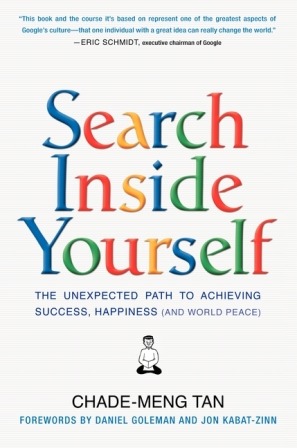
Search Inside Yourself


Search Inside Yourself is a book written by early Google employee Chade-Meng Tan, whose goal is to "create the conditions of world peace".  And he wants to do this by making people happy, based on the premise that happiness creates peace.  This is essentially a book on meditation written from the point of view of an engineer.  The book is simply and humorously written, but here's an EVEN simpler summary:  5 lessons for those who don't have the time to read an entire book just to be happy.


1. Meditation is scientifically proven to work!
      As befitting an engineer, Meng spends a good amount of time proving why you should meditate.  He explores studies on the "happiest man on earth" and scientifically defines happiness, how to measure it, and how the practice of meditation can increase it.  He then demonstrates how improved happiness yields improved emotional intelligence and how this has a strong correlation with success in the business world (even for engineers).

2. Mindful meditation is not about controlling emotions, it is about observing them at "higher resolution"
      Meng makes the assertion (again through scientific data) that people who are good at meditation do not shut off anger or pain.  They actually react more quickly to those emotions because they are more aware of them.  But by recognizing their emotions more clearly, they are able to recover from the emotions much more quickly and make choices on how they want to react.

3. Meditation is just breathing, and you're doing it right.
     If you're looking for detailed meditation practices, this book is not it.  Meditation is simply focusing your mind, and in this book, that simply involves observing your natural breath.  Two analogies really sticks.  Meditation is like exercise.  You are training your "brain muscles" to focus on something (like your breath).  When you lose focus, you just bring it back.  Losing focus is not failure.  It's an opportunity to exercise you brain and bring focus back.  Like doing bicep curls, losing focus, and then regaining focus is exercise.   Maintaining focus is like riding a bike.  You lose balance, then regain balance.  When you are able to do this quickly, it looks like you are balanced.  Likewise, you will always be losing focus and regaining focus.  When you can constantly regain focus quickly, it looks like you ARE focused.

4. Personal Motivation
    To be happy and successful, you have to know what that means to you.  First step is Alignment: knowing what you're looking for.  The next step is Envisioning: setting a vision for future happiness.  The final step is Resilience: the ability to keep moving towards your goals despite setbacks.   The last bit requires a positive attitude.  Rationally, if 51% of things are going well in your life, you should be happy.  However, negative results have 3 times the impact on our brains compared to positive results.  This makes being happy difficult.  Meng suggests that to counteract this, you think of neutral events as positive.  For example "I'm not in pain right now."  "I am well fed."
     
5. Habits for Social Interactions
   Empathy has been proven to help people succeed, and it feels good too.  The key to this is approaching people and thinking "This person is just like me."  If you have trouble empathizing, Meng believes that this is something that can be practiced.  You can literally set an alarm every day that says "Wish for people to be happy."  By doing it, you ARE empathizing, and soon this becomes natural.  Again, you are "exercising".


8/29/2012

A Perfect Mess

A Perfect Mess is a book by Eric Abrahamson and David Freedman that explores the hidden benefits of disorder.  The book is a short and easy read that recaps the concept of balance when it comes to mess.  Although no deep studies or revolutionary ideas were revealed, the book does confront the concept of "mess" in culture and its implications on our psyche. People who are uncomfortable with their mess will find solace in the book's message and perhaps perfection in their own mess.
  1. There is an optimal amount of mess.
  2. Tidiness can be expensive.
  3. One person's order is another person's mess.  You can never please everyone with order.  For example, you can organize books alphabetically, chronologically, by genre, or by color of the covers.  All are valid depending on your perspective and intended function.
  4. Mess can apply to both home and work, physical space and processes.  From a messy kitchen and desk, to corporate strategies and sales plans.  In each of these areas, there is a functional and optimal amount of mess.
  5. "Plan early, plan twice."

8/08/2012

Outliers

Outliers is a book by Malcolm Gladwell that answers the question: "How did outrageously successful people, these outliers, get to where they are?" Through exploration of athletes, entrepreneurs, and scientists, Gladwell makes the case that these successful outliers is a product of every society through a combination of upbringing, opportunities and timing. The popular notion that personal success is the result of genius and hardwork is faulty. Rather, Genius and hardwork is only the beginnings of a potentially successful life. The person's community and society plays a larger part in determining success.
  1. The perfect birth date for a Canadian hockey player is in January. Due to the January 1 cut-off date for the Canadian drafting season, boys born in January will always be larger than their counterparts during selection. This small difference in size in the beginning then triggers a waterfall of advantages for the January boy. This drafting cut-off has since been updated to four different dates throughout the year. But arbitrarily selected cut-off dates in society can have profound impacts on an individual's chances in life.
  2. Chinese children test better in math because of their language structure and rice-agriculture past. Chinese numbers are all single syllabic and logically constructed. As a result, Chinese-speaking toddlers can easily count to 100 while English-speaking toddlers can only count to the twenties. Math is also a subject that requires persistence, and persistence is a highly-valued Chinese trait as evidenced by folklore and poems throughout Chinese history. Gladwell postures that the importance of persistence was a construct of rice-agriculture, which requires heavy management and rewards the harder working farmer. These two features of Chinese culture, emphasis on persistence and a simple and logical language for numbers, gives Chinese children a distinct advantage when it comes to mathematics.
  3. Disasters are most often caused by a series seven micro events rather than one large event. This was the case for airplane crashes, which are usually caused by some combination of poor weather, tired pilots, decreased visibility, equipment failure on the plane, equipment failure on the airport, and mis-communication.
  4. Twenty-one is the perfect age to be when societal opportunities present itself. Consider Rockefeller and Carnegie who were born in the 1830s and in perfect maturity to take advantage of the oil boom. Or Bill Gates, Bill Joy, James Gosling and Steve Jobs, all born in 1954-1955 and in perfect maturity to take advantage of the computer revolution. A twenty-one year old is young enough to accept the risks of a new opportunity while old enough to appreciate new opportunities. Twenty-one year-olds are also old enough to have earned 10,000 hours of practice in some discipline in preparation for said opportunity.
  5. You don't need to be the smartest, you just need to practice for 10,000 hours. Those who succeed are all smart enough, but not necessarily geniuses. At some IQ mark, increased genius has a diminishing return. Rather, practice of 10,000 hours is what differentiates the winners. This is true in musical "geniuses," computer "geniuses" or even science "geniuses."