Aptrinsic

5/24/2016

Mind the Product Conference 2016 Summary

I went to Mind the Product conference in SF last month.  My company sponsored a booth to do some brand marketing and PM recruitment.  

The event was hosted at Davies Symphony Hall which is a concert hall with one seating area.  The event sold out weeks ago, and the auditorium was packed at the keynote.  There was only one track, here it is: 


I sat through all the talks, mostly because it was not so easy to get in and out of the auditorium.  We do live in a torrential downpour of TED talks and product advice books these days, so the bar is fairly high for good curation.  It is clear that there is pent up demand for a conference such as this given the audience size, however the hosting organization is still in early days and the program quality shows.  I would like to point out two particular talks that stood out for me though, and a third you might want to get a listen to yourself.

Ken Norton

Ken Norton is a partner at Google Ventures. His opening keynote compared a Product Manager first to an orchestra conductor, then, more aptly to a jazz musician.  He’s an incredibly good storyteller and his jazz analogy played well in the concert hall conference space.  I am a huge fan of Ella Fitzgerald period music.  So he resonated very well with me when he pointed out that Ella’s version of Mack the Knife was actually a happy accident of forgotten lyrics.   Because the band / team was so in tune with each other, they continued to improvise their way to a Grammy winning live recording.  He gave an example of a Miles Davis recording to illustrate that “the only mistakes were the opportunities that were not taken,” referring to an accidental cymbal crash that launched a perfect trumpet solo.  The (product) creation process is messy and uncomfortable, and a team that tunes into each other and let each other solo will come out with a Grammy. 


Abby Covert

Abby Covert is an IA consultant, helping her clients untangle information architecture messes.  My team is facing just such a challenge with DAC right now. So I found her talk compelling.  My most memorable analogy from her was the pizza example. Imagine you’re drawing a diagram to show aliens how to make pizza.  Something like this will probably leave them scratching their heads:

She suggested a diagram that shows both the process and the results. Like this:


Her other main tips were: 
  1. Language matters
    1. How many duplicative nouns and verbs are you dealing with?  Your goal is not to decide on one, but to actively decide how many are appropriate. Make a glossary.
  2. There is no right way.
    1. Classifying eggplant and tomatoes as fruit in an online grocery delivery service reduced sales on those items. Instead classify them as vegetables. Often word choice is not a matter of taxonomy, but rhetoric.
  3. Draw a picture


Des Traynor

Des Traynor is the co-founder of Intercom. His talk was on survival, and the idea that your product is already out of date, right now, as we speak. He was full of good tips, observations of general technology trends and comedic timing. I recommend watching to get the full effect, whenever the conference organizers post the talks. Here are some highlight points:
  • Your product is not a set of screens.  It is not a single destination but part of a system. Where and how your users interact with your system will always change. Plan for it.
  • Every time you see a new upstart, the urge is to laugh at it. The GPS industry did and and Google maps had the last laugh (for now). It can happen to you. The main question you need to ask when you see an upstart: Does [new technology] make it cheaper, faster or easier for our customers to make progress in their lives?  If you see it coming from far enough, hustle and pivot.
  • Three main trends he sees are:
    • Integrations
      • Software tools are now part of a wider network of capability.  If you’re not connected, you’ll be rejected.
      • Spot on!  My work on Atlassian Marketplace rides this trend by enabling a network of tools for Atlassian customers 
    • Artificial Intelligence
      • Computers can learn in seconds what we can learn in a lifetime.  Companies with data that can be used to train computers will have the edge in the upcoming race. 
    • Messaging 
      • You product needs to part of the conversation.  Selling pizza? You need to suggest it when two friends are on Facebook messenger chatting about dinner plans.  It’s called conversational commerce.

So how was the conference?  From talking to other attendees, it seems about 20% of the talks were worth it, which is probably near or just below average. Conferences like this are for networking, and networking opportunities is an area for improvement.  There were no meet-and-greet areas, birds-of-a-feather lunches, or walls of sticky notes to bond over.  And you know how Product Managers love sticky notes.  The conference promoted a tinder-for-networking app, which did not yield a single match for me, since only about 30 people logged in.  There is much to improve upon next year. They’ve clearly struck gold in terms of market demand, and I imagine it can only get better from here.


5/23/2016

Happier at Home

I read Happier at Home by Gretchen Rubin a long time ago and just got around to publishing my notes on it. As I re-read my notes, I get the feeling that this book is jam packed of little tips similar to ‘Don’t sweat the small stuff.” So here’s the download:

  1. On emotions: Under-react to a problem.
  2. On connection: "Enter into the interest of others.” -Tolstoy
  3. On self control: “Limits set you free.”  You drain your self control with every decision your make. Preserve your self control reserve by setting limits to automate your decisions.  The nuance is that limit-setting will be different for moderators vs abstainers. I am a moderator and my husband is an abstainer.  I can eat 2 chips out of a bag and close it for another sitting, but he will lick the bag before he stops. So my limit would be 2 chips per day, and his limit would be no chips except of 1 bag on Sunday. 
  4. On Possessions: People have different tolerance for an optimal number of possessions.  Ownership can bring joy too and stuff can also be an experience.  I live on the low-count end of the spectrum and my husband lives on the high-count end.
  5. On Purging:  Allow yourself to keep a few symbolic items per category to make purging easier.  When my parents sold the house I grew up in, I took pictures of my possessions there before purging 100% of it.  Knowing I can still see the pictures helped me let go of these objects I no longer needed. 
  6. On Happiness: Beware of happiness leaches.  Hang out with Tiggers not Eeyores. 
  7. On Positivity: Make the positive argument.  When you are about to complain about spouse or children such as thinking "He's so messy,”  Try to argue the opposite.  For example, thinking “He’s so clean,” and look for evidence of it. 
  8. On Exercise:  Get a dog.  All you have to do is put on your running shoes and close the front door.

2/25/2016

Are you a Maximizer or Satisficer?


I was listening to a Coursera course on  A Life of Happiness and Fulfillment  in which I was asked to take a Maximization test to determine whether I’m a Maximizer or Satisficer.  Maximizer tends to optimize the choices they make, where as satisficers is happy with the good enough option.  I’m a maximizer.  No surprise there since I Yelp every restaurant I visit and love comparison shopping on Amazon.  With choices come the tyranny of choice. How should Maximizers like me handle it?  


  1. Choose when to choose. We can decide to restrict our options when the decision is not crucial. For example, make a rule to visit no more than two stores when shopping for clothing.
  2. Learn to accept “good enough.” Settle for a choice that meets your core requirements rather than searching for the elusive “best.” Then stop thinking about it. Don’t worry about what you’re missing.
  3. Consciously limit how much you ponder the seemingly attractive features of options you reject. Teach yourself to focus on the positive parts of the selection you make.
  4. Control expectations. “Don’t expect too much, and you won’t be disappointed” is a cliché. But that advice is sensible if you want to be more satisfied with life.

2/16/2016

Resources about Allergies

I write for TriplePundit on occasion, and I had one article about the worrisome and growing trend on allergies. A reader wrote to me to share her research on the topic. So I’d like to share them here with you.  This reader shared the first survey above (Mothering & TummyCalm Survey) to with her mommy friends dealing with their kid's food allergies, and found it to be a great conversation starter and educational at the same time.

2/08/2016

Google hosts Women Techmakers March 5th 2016

Google is celebrating International Women's Day by hosting a Techmakers conference. Apply to participate at a Google office around the world.

2/06/2016

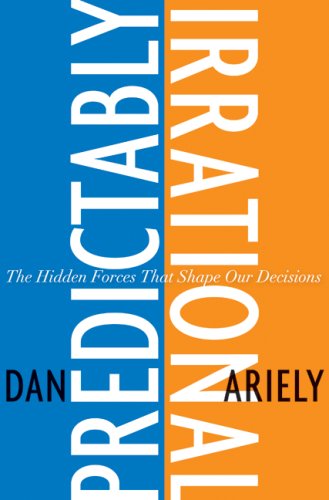
Predictably Irrational by Dan Ariely

Predictably Irrational, a book by MIT professor Dan Ariely, uncovers the hidden forces that shape our decisions. It is such a fun read that I finished the book in 2 days. The book teaches the reader about psychology and how it manifests in everyday life.

  1. People don't know what they want unless the options are presented in context. Price the item you want to sell in the middle of the price ranges presented. It takes less thinking to choose the middle-priced item. He found that adding higher priced items on a menu will increase overall restaurant revenue even if those high-priced items are never ordered. Bring a "wing-man" who is less attractive than you when going out to a club to meet potential mates.
  2. Anchoring has a major long-term effect on our willingness to pay. Students were asked to write down the last two digits of their SSN before choosing a price for a random item would tend to pay higher if their SSN was a higher number. House buying has the same effect, those moving to more expensive areas squeeze into a small house, while those moving to cheaper areas buy a mansion, regardless of their actual space necessities. Knowing the impact of anchoring, train oneself to question repeated behaviors. And pay particular attention to the first decision in a long stream of decisions.  While it may seem like just one decision, it has an impact on future decisions for years to come.
  3. "Free" makes us perceive what is being offered as immensely more valuable than it really is. People will wait in line for absurdly long times to get something for free. And free is one of the most powerful ways to trigger behavior This is because we are loss averse. Say we increase our happiness by 5 units when we win $10, when we lose $10, we should logically reduce our happiness by 5 units, but in reality we decrease our happiness by more than 5 units. 
  4. Above is the reason we overvalue what we own.  This is called the "endowment effect."  When we own something, we begin to value it more than other people do. 
  5. Getting paid to do something triggers 'market norm' where as doing something for free triggers 'social norm'. And people will often work harder under non-monetary social norms than for payment!  For example, when AARP asked lawyers to work for $30/hr representing the needy, no one signed up, but when asked to work for free, an overwhelming number did. It's helpful to know that small gifts don't constitute a market norm, and keep things in the social realm. Companies that market based on social norms ("like a good neighbor...") but fail to follow through (e.g. imposing nuisance fees) are violating a social contract with their customers, who may take personal offense when a relationship framed as a social exchange turns out to be a market one.
A really good detailed summary of the book can be found here.

2/05/2016

How Frustration can make us more Creative


In this TED Talk, Tim Harford tells a few excellent stories about how to inject a little mess when you are stuck on a problem.  Here are some ways to inject that mess:
  1. Reduce your attentional filter, let the noise in and let it mellow. It helps you think outside the box.
  2. Invite a stranger into your conversation.
  3. Play with some Oblique Strategies cards, these cards by Brian Eno was used to unblock musicians
  4. "Just because you don't like it doesn't mean it isn't helping you."
  5. Play the un-playable piano: introduce troublesome constraints to your situation so you have to innovate around it.