Google is celebrating International Women's Day by hosting a Techmakers conference. Apply to participate at a Google office around the world.

2/06/2016
Predictably Irrational by Dan Ariely
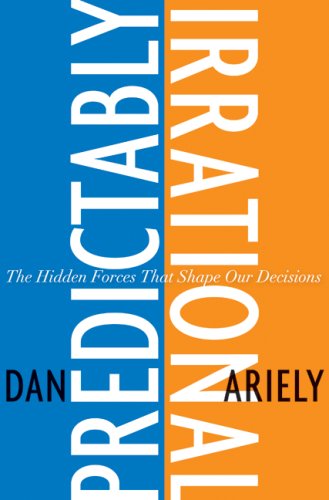
- People don't know what they want unless the options are presented in context. Price the item you want to sell in the middle of the price ranges presented. It takes less thinking to choose the middle-priced item. He found that adding higher priced items on a menu will increase overall restaurant revenue even if those high-priced items are never ordered. Bring a "wing-man" who is less attractive than you when going out to a club to meet potential mates.
- Anchoring has a major long-term effect on our willingness to pay. Students were asked to write down the last two digits of their SSN before choosing a price for a random item would tend to pay higher if their SSN was a higher number. House buying has the same effect, those moving to more expensive areas squeeze into a small house, while those moving to cheaper areas buy a mansion, regardless of their actual space necessities. Knowing the impact of anchoring, train oneself to question repeated behaviors. And pay particular attention to the first decision in a long stream of decisions. While it may seem like just one decision, it has an impact on future decisions for years to come.
- "Free" makes us perceive what is being offered as immensely more valuable than it really is. People will wait in line for absurdly long times to get something for free. And free is one of the most powerful ways to trigger behavior This is because we are loss averse. Say we increase our happiness by 5 units when we win $10, when we lose $10, we should logically reduce our happiness by 5 units, but in reality we decrease our happiness by more than 5 units.
- Above is the reason we overvalue what we own. This is called the "endowment effect." When we own something, we begin to value it more than other people do.
- Getting paid to do something triggers 'market norm' where as doing something for free triggers 'social norm'. And people will often work harder under non-monetary social norms than for payment! For example, when AARP asked lawyers to work for $30/hr representing the needy, no one signed up, but when asked to work for free, an overwhelming number did. It's helpful to know that small gifts don't constitute a market norm, and keep things in the social realm. Companies that market based on social norms ("like a good neighbor...") but fail to follow through (e.g. imposing nuisance fees) are violating a social contract with their customers, who may take personal offense when a relationship framed as a social exchange turns out to be a market one.
A really good detailed summary of the book can be found here.
2/05/2016
How Frustration can make us more Creative
- Reduce your attentional filter, let the noise in and let it mellow. It helps you think outside the box.
- Invite a stranger into your conversation.
- Play with some Oblique Strategies cards, these cards by Brian Eno was used to unblock musicians
- "Just because you don't like it doesn't mean it isn't helping you."
- Play the un-playable piano: introduce troublesome constraints to your situation so you have to innovate around it.
2/03/2016
Speed as a Habit

- "If, by way of habit, you consistently begin every decision-making process by considering how much time and effort that decision is worth, who needs to have input, and when you’ll have an answer, you'll have developed the first important muscle for speed."
- "This isn’t to say all decisions should be made quickly. Some decisions are more complicated or critical than others. It might behoove you to wait for more information. Some decisions can’t be easily reversed or would be too damaging if you choose poorly. Most importantly, some decisions don’t need to be made immediately to maintain downstream velocity."
- "You know you're going fast enough if there's a low-level discomfort, people feeling stretched. But if you're going too fast, you'll see it on their faces, and that's important to spot too."
- "It's important to internalize how irreversible, fatal or non-fatal a decision may be. Very few can't be undone."
- "Challenge the when."
9/16/2015
How to find fulfilling work by Roman Krznaric

- An important question to answer first: Are you trying to find fulfilling work, or are you trying to have work that supports a fulfilling life?
- There are a couple of exercises worth doing as you start your discovery of fulfilling work, they are
- Map of Choices - Map out your career thus far and note the primary motivations for each transition, your motivation list: Status, Respect, Talent, Making a Difference, Passions, Money. Then stack rank your motivations based on what you want going forward.
- Imaginary lives - Imagine you have 5 parallel lives, what career does each of your 5-selves have?
- Reverse JD - If newspapers do not have job descriptions but instead of people looking for jobs, what does yours look like? Share this with 10 friends from diverse work backgrounds and see what they’ll hire you for.
- Fulfillment is derived from 1) meaning 2) flow and 3) freedom (or autonomy). This is very similar to the Dan Pink TED talk.
- Now that you have some idea of what careers you might want to try, do these to fast-prototype your ideas:
- Discovery Conversations - talk to people who do the work, learn about it.
- Branching projects - Take a few hours, a day or weeks to try projects in the careers you desire. Do internships, volunteer, or contract for someone.
- Radical sabbatical - Take months to a year off from your current work and do short stints at potential work you want.
- Do the 5 Whys. This wasn’t mentioned in the book, but is an exercise inspired from my Six Sigma quality management training that I found applicable in conjunction with the Map of Choices and the stack rank of Motivations. For each motivation, ask the 5 whys. You might not get 5 answers but go as deep as you can. For example here is my 5-whys map for Talent. Talent —> Feel Useful —> Be included —> Social safety, relevance, camaraderie and friendship. Social safety and relevance had further whys —> survival —> shelter, food, clothes. Turns out the reason I wanted my talent used is because I wanted 1) a sense of camaraderie and friendship, and 2) I tied it to my basic survival. This help me eventually breakdown into source-needs that were more important than the motivations given in the book. Your 5-whys map will be different, but I encourage you to try it.
9/08/2015
Ricardo Semler TED Talk: How to run a company with (almost) no rules
I greatly enjoyed Ricardo's talk. It was both entertaining and informative. It will change the way you look at life, rules and business.
- "Everyone wants to leave a legacy. But why do you want to be remembered?"
- "If you are giving back you took too much."
- Have a terminal day a week, or two. Imagine if your doctor told you that you had 6 months to live, you'd make a bucket list right? Use Terminal days to strike down that list before the doctor ever gave you the news.
- The opposite of work is not leisure, but idleness.
- Free yourself from the anchor of past achievements so you can start something new. Ricardo burned his life's achievements in a bonfire so that 1) his kids won't have the shadow of his footsteps to haunt them, and 2) he can start anew.
8/19/2015
What every product manager needs to know about product analytics

This is a great blog post for Product Manager everywhere written by my colleague Sam. Here are the 5 lessons I learned from it:
- Adding analytics generally involves adding a line of code here and there to fire an event when a user performs an action in your product. Some frameworks for adding analytics events and tracking them include Google Analytics and KISSmetrics.
- Empathy Debt = lack of information about the state of your customer's love (or hate) for your features
- "There’s nothing worse than getting to the end of an experiment and realizing you don’t have all the events you need. Try to do your analysis before you run the experiment using some dummy data so you can see any gaps in what you’re capturing."
- Create 2-3 very different versions of the feature you're trying to test. The key is to keep them very different. Deploy all of them and track results.
- It’s great to be data-informed, but being entirely data-driven can sometimes leave you blind to the overall experience. The data tells you how they are behaving but not why, so talk to the users as well to get a rounded picture.
Subscribe to:
Posts (Atom)